
How to Learn to Fly in New Zealand: A Beginner’s Guide for Student Pilots
Learning to fly in New Zealand usually starts with a trial flight or introductory lesson at a flight school or aero club. From there, students can train toward a Private Pilot Licence if they want to fly recreationally, or continue toward a Commercial Pilot Licence if they want an aviation career. Along the way, pilots need flight training, theory exams, a medical certificate, an accurate logbook, and the right flight school for their goals. NZAviator helps future and current pilots explore flight schools in New Zealand, prepare for exams, and start tracking their aviation journey from day one.
How Do You Start Learning to Fly in New Zealand?
The easiest way to start learning to fly in New Zealand is to book a trial flight or introductory lesson with a local flight school or aero club.

A trial flight gives you a first experience in the aircraft, lets you meet an instructor, and helps you understand whether flying is something you want to pursue seriously. You do not need to know everything before your first lesson. A good instructor will explain the aircraft, the basic controls, what to expect in the air, and what the training pathway looks like.
After that first flight, the next step is usually to choose a training path.
Some students want to fly for fun. Others want to become commercial pilots, instructors, airline pilots, agricultural pilots, helicopter pilots, or aviation professionals. Your goal matters because it affects the type of training organisation, aircraft, cost, location, and licence pathway you choose.
CAA explains that someone intending to fly for recreation may choose a microlight certificate or Private Pilot Licence, while someone planning an aviation career can train toward a Commercial Pilot Licence or Airline Transport Pilot Licence. CAA also notes that flying lessons are only part of training, and pilots also need a medical examination, fit and proper person test, English language proficiency, and theory exams.
The Usual Pilot Training Pathway in New Zealand
For many New Zealand pilots, the pathway looks like this:
Trial flight
Student pilot training
First solo flight
Private Pilot Licence
Additional ratings or endorsements
Commercial Pilot Licence
Instructor rating, instrument rating, multi-engine training, airline pathway, or other specialist training
Not every pilot follows the same pathway. A person learning to fly helicopters may follow a different practical route from someone learning in a fixed-wing aircraft. A person flying recreationally may stop at PPL, while someone aiming for aviation employment may continue into CPL and beyond.
The important thing is to understand your goal early, then choose a flight school that can support that pathway.
Private Pilot Licence or Commercial Pilot Licence?
A Private Pilot Licence (PPL) is normally the pathway for people who want to fly recreationally or privately. It allows pilots to build skills, carry passengers within the privileges and limitations of the licence, and continue into further ratings or advanced training.
A Commercial Pilot Licence (CPL) is for pilots who want to work as pilots. If your goal is to fly professionally, you will usually need to train beyond PPL level and meet CPL requirements.
CAA’s pilot licensing information explains that pilots intending to fly recreationally can choose a microlight certificate or Private Pilot Licence, while pilots intending to build a career in aviation can train toward a Commercial Pilot Licence or Airline Transport Pilot Licence.
Medical Requirements for Student Pilots
You should talk to your chosen flight school early about medical requirements.
CAA states that to become a licensed pilot or an air traffic controller, you must have a medical certificate.
For PPL flying, CAA also provides guidance around PPL privileges using a DL9 driver licence medical certificate, noting that the DL9 must be at least a Class 2 medical certificate with passenger endorsement.
The safest approach is to speak with your flight school and check current CAA medical requirements before you invest heavily in training. If your goal is commercial aviation, ask about Class 1 medical requirements early so there are no surprises later.
Choosing a Flight School in New Zealand
Choosing the right flight school is one of the most important decisions you will make as a student pilot.
There is no single “best” flight school for every student. The right school depends on your location, budget, learning style, aircraft preference, career goal, instructor availability, and whether you want fixed-wing or helicopter training.
When comparing flight schools in New Zealand, look at:
Location and travel time
Aircraft type and fleet condition
Instructor availability
Training structure
PPL and CPL pathways
Aircraft hire rates
Instructor rates
Landing fees and other costs
Weather patterns in the region
Controlled or uncontrolled airspace
School culture
Student reviews
Exam support
Career pathway support
Availability of trial flights
Whether the school suits recreational or professional training
Some students prefer a busy controlled aerodrome because it gives them more radio and airspace experience. Others prefer a quieter training environment where they can focus on core handling skills. Neither option is automatically better. It depends on the student.
Browse Flight Schools in New Zealand by Region
NZAviator includes a flight school directoryto help future pilots explore training options across New Zealand.
If you are not sure where to start, browse flight schools by region and compare what each provider offers. You can look at location, aircraft type, training pathways, school profile, and whether the school aligns with your goals.
Future pilots often search for:
Flight schools in Wanaka and Queenstown
Flight schools in Bay of Plenty
Flight schools in Nelson, Marlborough and Tasman
Flight schools in Manawatu and Whanganui
A student in Auckland may have different priorities from someone learning in Wanaka, Christchurch, Tauranga, Hamilton, Nelson, or Dunedin. Weather, airspace, terrain, aircraft availability, and instructor access can all affect the training experience.
What Should Student Pilots Track From the Beginning?
A pilot logbook becomes one of the most important records in your aviation journey.
Even when you are just starting out, your flight records matter. Your logbook will eventually show your training history, flight experience, aircraft flown, instructors, routes, take-offs, landings, pilot functions, and progress toward licences and ratings.
CAA Part 61 states that every entry in a pilot’s logbook must be made within 7 days after the flight, except for international air transport operations, where the entry must be made within 14 days. If a pilot is operating away from the base where the logbook is normally kept, the entry must be made within 48 hours after returning to base.
From day one, student pilots should track:
Date of flight
Aircraft type
Aircraft registration
Instructor name
Pilot function
Dual time
PIC time when applicable
Day and night time when applicable
Instrument time when applicable
Route or local flight details
Take-offs and landings
Exercises completed
Remarks and training notes
Medical expiry
Endorsements
Exam results
Training sign-offs
The earlier you build good logbook habits, the easier your aviation journey becomes later.
Why a Digital Logbook Helps Student Pilots
A paper logbook is important, but it has limits.
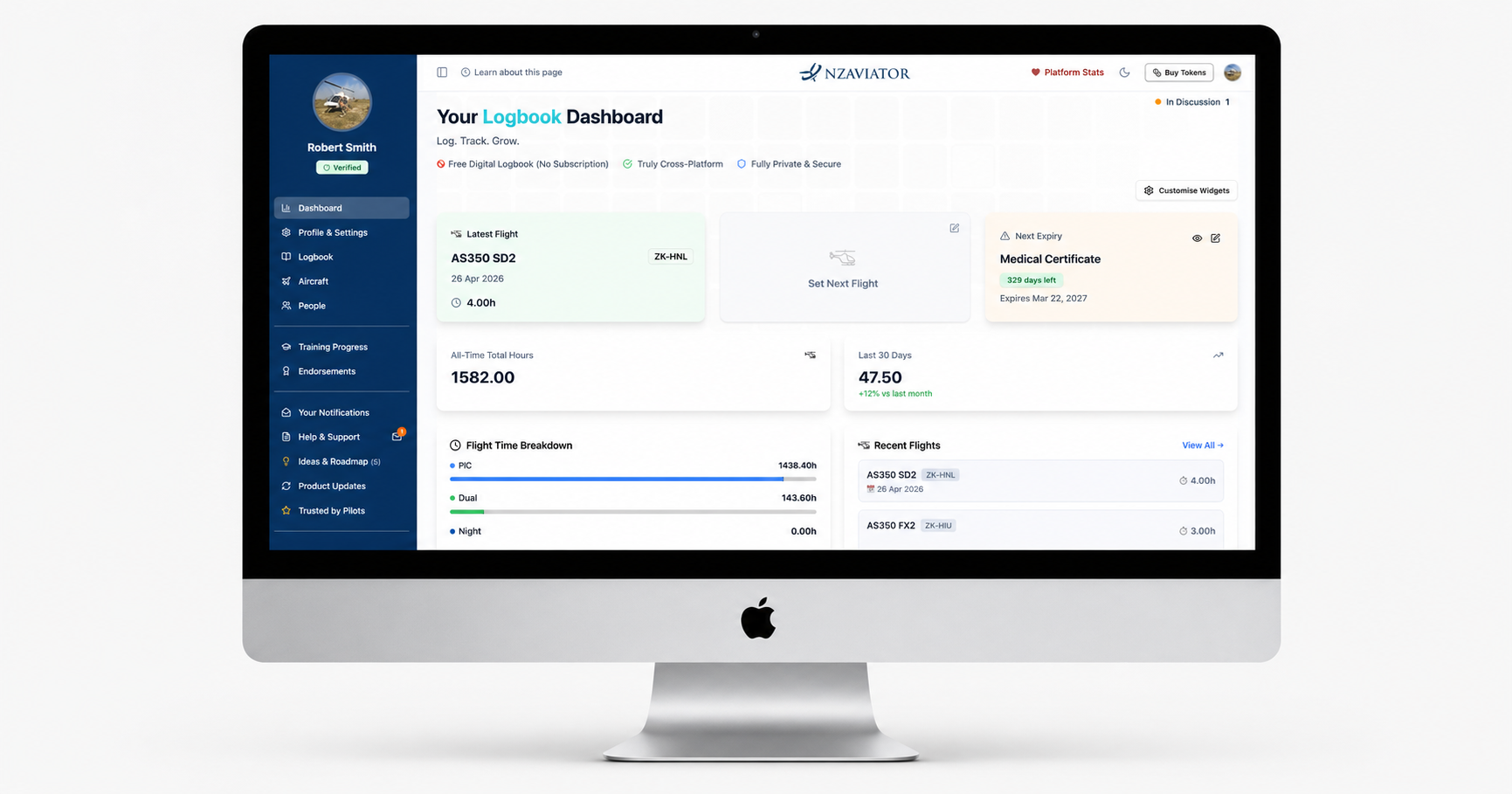
It records your flights, but it does not automatically show trends, graphs, currency, instructor history, aircraft breakdowns, or training progress. If you want to know how much dual time you completed with a specific instructor, how many flights you completed on a certain aircraft, or how your hours are growing month by month, a paper logbook can be slow to analyse.
That is where a digital logbook helps.
A digital pilot logbook can make your training data easier to understand. It can help you see your totals, track your hours, review recent flights, organise aircraft, manage people connected to your flying, and generate cleaner reports.
NZAviator gives New Zealand pilots a free digital logbook designed around NZ pilot training, CAA-style fields, aircraft records, people records, training progress, endorsements, and reporting.
How NZAviator Helps People Learning to Fly
NZAviator is built to support New Zealand pilots from the beginning of their aviation journey.
For someone learning to fly, NZAviator can help with three important areas:
First, it helps you explore flight schools in New Zealand through the NZAviator directory.
Second, it helps you prepare for aviation theory through NZAviator mock exams and study tools.
Third, it helps you track your flight training with a free digital pilot logbook.
As your training develops, your data becomes more valuable. Flights, aircraft, instructors, hours, take-offs, landings, endorsements, exam results, and training progress all start to form a clearer picture of your aviation journey.
Instead of leaving that information scattered across paper, spreadsheets, notes, and emails, NZAviator helps bring it into one place.
What to Ask a Flight School Before You Start
Before choosing a flight school, ask practical questions.
How much does a trial flight cost?
What aircraft do you train on?
What is the hourly aircraft hire rate?
What is the instructor rate?
Are landing fees included?
How often can students book lessons?
How far ahead do students need to book?
Do you offer PPL training?
Do you offer CPL training?
Do you train fixed-wing, helicopter, or both?
Do you provide theory exam support?
How do you track student progress?
How many instructors are available?
What happens if my instructor leaves?
Can I train part-time?
Can I train intensively?
What medical do I need?
When can I start logging flights?
Do you help students prepare for their first solo?
Do you support students after PPL?
A good flight school should be comfortable answering these questions clearly.
How Often Should You Fly When Learning?
Consistency matters.
Many students progress faster when they fly regularly because skills stay fresh between lessons. If you leave long gaps between flights, you may spend more time revising previous exercises before moving forward.
However, every student has different limits. Work, budget, weather, aircraft availability, and instructor availability all affect training pace.
The key is to create a realistic plan with your instructor and review your progress regularly.
NZAviator can help by making your flight history and training progress easier to see over time.
How Much Does It Cost to Learn to Fly in New Zealand?
The cost of learning to fly in New Zealand varies significantly.
It depends on the type of aircraft, flight school, location, aircraft hire rate, instructor rate, landing fees, theory exam costs, medical costs, how often you fly, and how quickly you progress.
Because pricing changes and each school has different rates, students should ask flight schools for a current estimate before starting. Ask for a full breakdown, not just an hourly aircraft rate.
Important cost areas include:
Trial flight
Aircraft hire
Instructor fees
Landing fees
Briefing time
Theory exams
Study materials
Medical certificate
Headset or equipment
CAA fees where applicable
Flight test costs
Additional training if needed
The cheapest school is not always the best option. A slightly higher hourly rate may still be better if the school has strong instructor availability, good training structure, well-maintained aircraft, and fewer delays.
Fixed-Wing or Helicopter Training?
New Zealand offers both fixed-wing and helicopter flight training.
Fixed-wing training is common for students aiming toward private flying, commercial aeroplane operations, instructing, airline pathways, or general aviation careers.
Helicopter training may suit students interested in utility work, tourism, agriculture, rescue, commercial helicopter operations, or specialised flying.
Both pathways require commitment, skill, and accurate logbook records. The right choice depends on your aviation goal, budget, location, and the type of flying you want to do.
What Happens After Your First Lesson?
After your first lesson, the school may recommend a training plan.
You may start learning basic aircraft handling, effects of controls, straight and level flight, climbing, descending, turning, circuit training, radio calls, emergency procedures, navigation, and other exercises.
Over time, your instructor will prepare you for solo flight, theory exams, flight tests, and future ratings.
Your logbook should grow alongside your training. Each flight becomes part of your official aviation history.
Start Tracking Your Aviation Journey Early
One of the best things a student pilot can do is start organised.
Even if your first few flights feel simple, they still matter. Your early dual flights, aircraft types, instructors, exercises, and notes become part of the story of how you learned to fly.
A clean digital record makes it easier to understand your progress, prepare for exams, review your training, and build confidence.
NZAviator helps student pilots organise their aviation journey from day one.
Final Answer: How Do You Learn to Fly in New Zealand?
To learn to fly in New Zealand, start with a trial flight at a flight school or aero club, decide whether your goal is recreational or professional flying, understand the licence pathway, check medical requirements early, choose the right flight school, keep an accurate logbook, and prepare for both practical training and theory exams.
Your flight school teaches you to fly.
Your logbook records your journey.
NZAviator helps you organise that journey, find flight schools, prepare for exams, and track your flying from the beginning.
FAQ
How do I start learning to fly in New Zealand?
Start by booking a trial flight or introductory lesson with a flight school or aero club. This lets you experience flying, meet an instructor, and understand the training pathway before committing to a full programme.
Do I need a medical certificate before my first flying lesson?
You should check with your flight school. CAA states that licensed pilots need a medical certificate, and medical requirements become especially important before solo flight and licence issue.
What is the difference between PPL and CPL in New Zealand?
A PPL is generally for private or recreational flying, while a CPL is for pilots who want to work commercially. CAA explains that recreational pilots may choose a microlight certificate or Private Pilot Licence, while career pilots can train toward a Commercial Pilot Licence or Airline Transport Pilot Licence.
How do I choose a flight school in New Zealand?
Compare location, aircraft, instructors, costs, weather, airspace, training structure, reviews, exam support, and whether the school supports your long-term goal. NZAviator’s flight school directory can help you explore schools by region.
Should student pilots use a digital logbook?
Yes, a digital logbook can help student pilots track flights, hours, aircraft, instructors, take-offs, landings, endorsements, and training progress. Pilots should still make sure they meet CAA logbook requirements.
How quickly should I start logging flights?
You should build good logbook habits from your first lesson. CAA Part 61 includes timing requirements for logbook entries, including that entries are generally made within 7 days after the flight.
Can NZAviator help me find a flight school?
Yes. NZAviator includes a flight school directory with profiles for flight schools across New Zealand, helping future pilots explore options by region.
Can NZAviator help with pilot exams?
Yes. NZAviator provides aviation mock exam tools and study support to help pilots prepare for theory exams alongside their flight training.
Start Your Flying Journey With NZAviator
Find flight schools in New Zealand, prepare for aviation exams, and start tracking your flying from day one with NZAviator.
Find Flight Schools in New Zealand
Start Your Free Digital Pilot Logbook
Prepare With NZAviator Mock Exams